Attractions
Playa Brava and Los Dedos: Surf, Safety and the Famous Hand
The story of Los Dedos, how to visit it, how the Brava paradas are numbered, where to surf and how to read the lifeguard flags.
In this guide
Before you go
Playa Brava is the Atlantic beach of Punta del Este, running east from the neck of the Península to the Arroyo Maldonado at La Barra. Its first parada holds Los Dedos, the hand rising from the sand that appears on almost every postcard of the city.
Visit the sculpture early in the morning or outside January if you want a photo without a crowd. Go into the water only when the flags allow it and near a staffed lifeguard post, because the Brava's waves and currents are real. Bring a windbreaker: even on hot days the Atlantic side can be cool and breezy.
Shade is scarce on the sand, so bring an umbrella or rent one where beach bars operate, along with water and strong sunscreen. Beach bars and rentals cluster around the low paradas and thin out farther east, where you should carry what you need for the day.
The story of Los Dedos
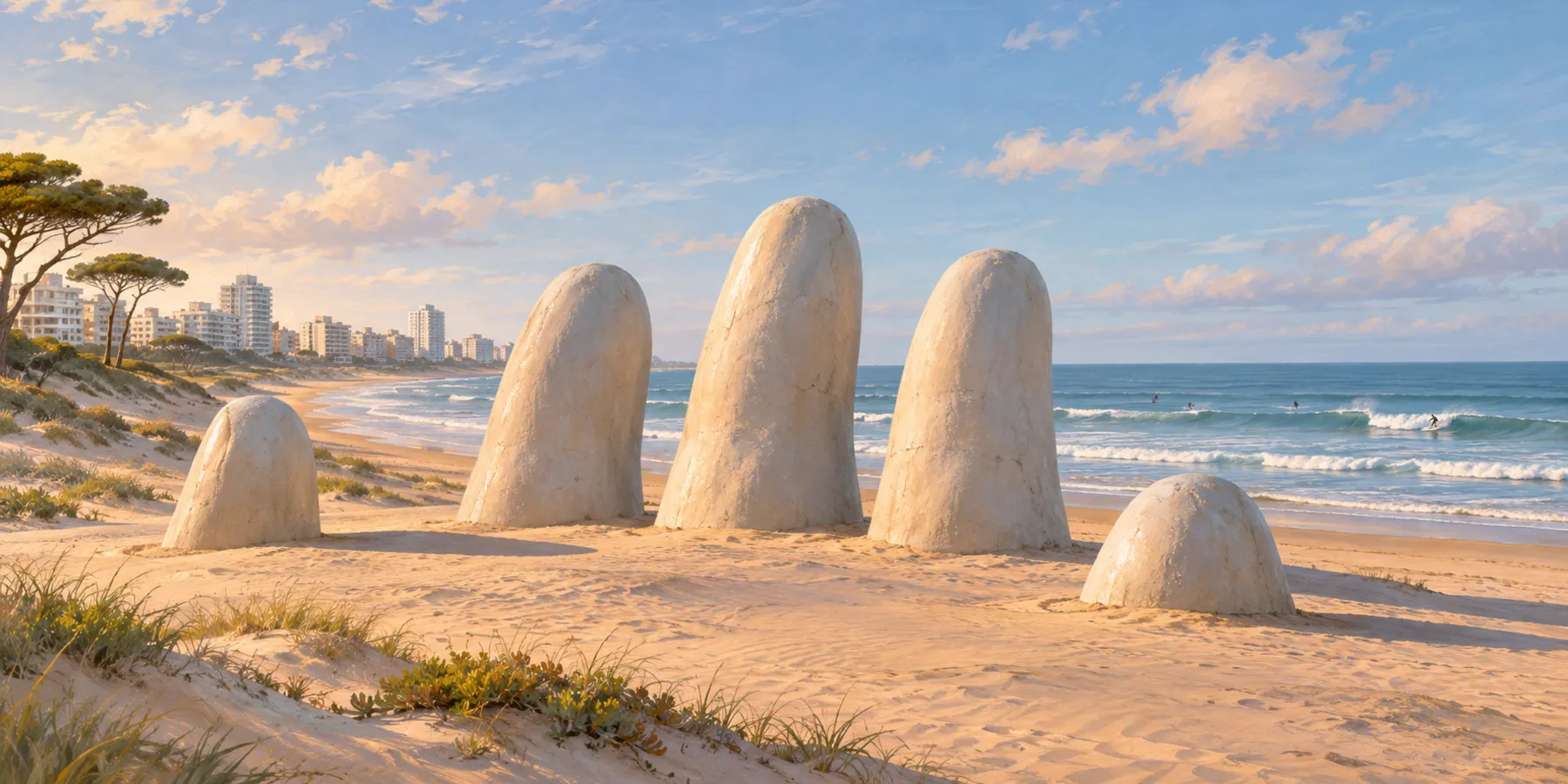
The sculpture's original title is Hombre emergiendo a la vida (Man Emerging into Life), but almost everyone calls it Los Dedos (The Fingers) or La Mano (The Hand). Chilean artist Mario Irarrázabal made it in the summer of 1982, during the first international meeting of modern open-air sculpture held in Punta del Este. He finished it in February of that year, in about six days, working in concrete reinforced with steel bars and metal mesh despite strong winds.
Several sculptors made works on the beach that summer; Irarrázabal's is the one that stayed and became a symbol of the city. Five fingers emerge from the sand as if from the sea, and many people read it as a warning to swimmers about the Brava's water. Irarrázabal later made other large hands for other places, but this one is the best known.
Visiting the sculpture
Los Dedos stands at Parada 1 of the Brava, where Avenida Artigas meets the beach, a few blocks from Avenida Gorlero. There is a roundabout and parking nearby, though spaces fill fast in summer, and it is an easy walk from anywhere on the Península.
The sculpture is free to visit at any hour. Midday in January brings queues for photos and souvenir sellers. Sunrise is quiet, and late afternoon light falls warmly on the fingers with the Península's towers behind them. Please do not climb on it or write on it: it has been vandalised before, and the municipality has had to restore it.
How the Brava paradas are numbered
Like the Mansa, the Brava is organised by paradas that start at 1 next to the Península. Each parada has a beach access point, and in season many have a lifeguard post, which makes the numbers the easiest way to meet friends or tell a taxi where to go. The numbers rise as you head east along the Atlantic toward La Barra. Parada 1 is Los Dedos; around Parada 3 is La Olla, a busy surf and beach bar area; around Parada 8 is another popular beach restaurant stretch. Beyond that, the beach becomes more residential, passing San Rafael before reaching the river mouth and the wavy bridge to La Barra.
Both beaches use the same numbers, so "Parada 5" alone is ambiguous. Say "Parada 5 de la Brava" in directions, taxis and rental listings. Our where-to-stay guide explains how the two sequences fit together.
Surf on the Brava
The Brava has swell all year and is the first stop for surfers in Punta del Este. La Olla, around Parada 3, is the best-known spot near town and has a surf school in season that accepts children from about four years old with no experience. Farther east the breaks continue toward La Barra and Manantiales, where Playa Montoya and Bikini are popular.
Most surfers wear a wetsuit for much of the year, because the Atlantic here is cool. Conditions change quickly with the wind, so check a forecast and ask at a surf school before paddling out at an unfamiliar parada. Keep clear of swimmers near lifeguard posts.
Flags and safety
The Intendencia de Maldonado runs one of Uruguay's largest lifeguard services in the summer season. The flags follow a simple code:
- Green: calm water, swimming allowed. Lifeguards say they never fly it on the Brava, because caution is always needed.
- Yellow: caution.
- Yellow and red: risky conditions, extreme caution.
- Red: no swimming.
- Red with a green cross: no swimming for health reasons, such as cyanobacteria.
- Black: electrical storm, leave the water.
A small red pennant on the shore marks a dangerous current. If one catches you, do not swim against it: swim parallel to the shore or float and raise an arm. Outside the lifeguard season, or outside staffed hours, treat the Brava as unguarded. Lifeguard hours and dates change each season, so check the Intendencia's current announcements.
Sunrise, walks and the other side
The Brava faces the open ocean to the east and southeast, so it is the place for sunrise. An early walk east from Los Dedos, with Isla de Lobos on the horizon, is one of the simplest pleasures in Punta del Este.
If you are staying on the bay side, the Brava is a short walk across the Península or a few minutes by car from the middle Mansa. From our apartment on Playa Mansa you can swim in calm water in the morning and drive across when the surf is up. For a side-by-side view, read Playa Mansa vs Playa Brava.
Frequently asked questions
Who made Los Dedos in Punta del Este?
Chilean artist Mario Irarrázabal, in the summer of 1982, during the first international meeting of modern open-air sculpture in Punta del Este.
Where exactly is Los Dedos?
At Parada 1 of Playa Brava, where Avenida Artigas reaches the beach, a few blocks from Avenida Gorlero.
Is Playa Brava safe for swimming?
Only with care. Swim near a staffed lifeguard post when the flags allow it. Lifeguards never fly the green flag on the Brava.
Can beginners surf on Playa Brava?
Yes, with a surf school. La Olla, around Parada 3, runs classes in season, including for children.
Is it free to visit Los Dedos?
Yes. It is on a public beach and can be visited at any time.
Sources and review notes
- La Mano de Punta del Este (Wikipedia) , checked 2026-11-13
- Playa Brava, Los Dedos (InfoCasas) , checked 2026-11-13
- Guardavidas responden dudas para un baño seguro (El Observador) , checked 2026-11-13
- La península de Punta del Este: el puerto, Gorlero y Los Dedos (El Observador) , checked 2026-11-13
Next editorial review: 13 May 2027