Uruguay practicalities
Money in Uruguay: Pesos, Dollars, IVA Benefits and Tipping
Pesos or dollars, paying by card, the IVA benefits for foreign visitors in the 2026-27 season, ATMs and how much to tip in Punta del Este.
In this guide
The short version
Pay by card, preferably one issued outside Uruguay, and carry a modest amount of Uruguayan pesos for small purchases. Many larger prices on the coast, especially accommodation and property, are quoted in US dollars, but everyday spending happens in pesos. Foreign visitors can save the IVA (Uruguay's value added tax) on several tourism services when they pay with a foreign card, and the government has confirmed a benefit for the 2026-27 summer season. Tip about 10% in restaurants when service is good, after checking the bill for a service charge.
Rules and benefits change from season to season, so check the official sources linked below before you travel.
Pesos or dollars
Uruguay's currency is the Uruguayan peso (UYU), usually written with a $ sign, which can cause confusion. When a price matters, check whether it is in pesos or in US dollars, often written as U$S or USD.
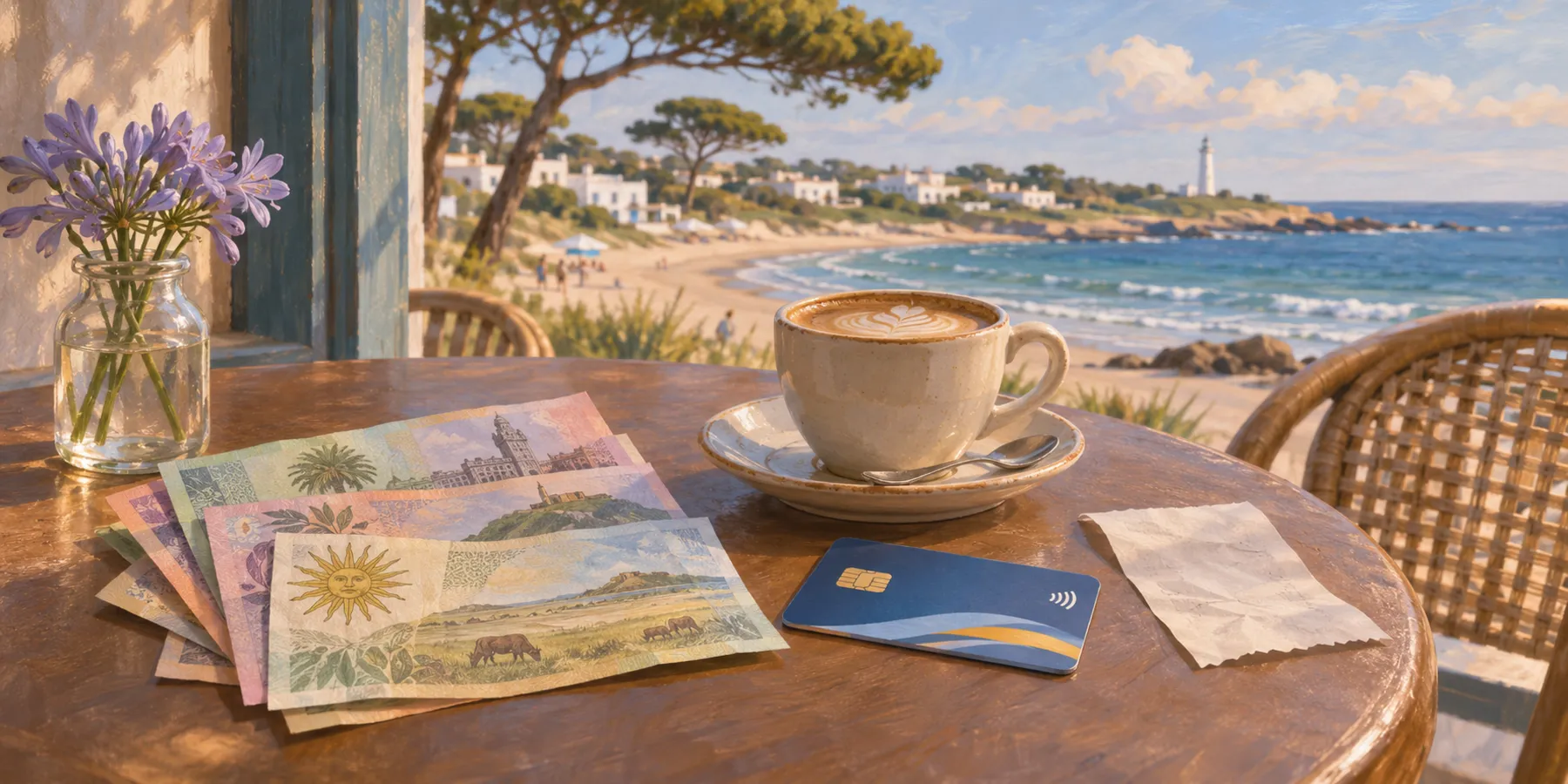
Pesos are the everyday currency: supermarkets, cafés, taxis, buses, pharmacies and most restaurants price in pesos. US dollars are widely used for larger amounts, such as rents, property, cars and some tourism services, and many businesses in Punta del Este will accept dollar cash, often at their own exchange rate. Paying in the currency of the price usually gives the best result.
Argentine pesos and Brazilian reais can be changed at exchange houses (cambios) in Punta del Este and Maldonado, but they are not a practical way to pay in shops. Compare the rate and commission before you change, and avoid changing large amounts at a time.
Paying by card
Cards are accepted almost everywhere in Punta del Este: supermarkets, restaurants, shops, petrol stations and most beach clubs. Contactless payment is common. Small kiosks, market stalls and some taxis may prefer cash, so keep some pesos for those.
When a card terminal offers to charge you in your home currency instead of pesos, decline it. This is usually a dynamic currency conversion with a worse rate than your bank's. Paying in pesos and letting your card issuer convert the amount is normally cheaper. Check your own card's foreign transaction fees before travelling.
Foreign cards matter for another reason: they are how visitors access Uruguay's IVA benefits.
IVA benefits for foreign visitors in the 2026-27 season
Uruguay has used IVA reductions for several seasons to attract foreign visitors. For the 2026-27 season the tax authority (DGI) has published the details of a total IVA reduction for non-resident individuals, valid for purchases between 15 November 2026 and 30 April 2027. According to the DGI, it covers:
- Food and drink services at restaurants, bars, cafés and similar businesses, and at hotels and other tourist accommodation when they are not part of the lodging charge.
- Catering and other services for parties and events.
- Car rental without a driver.
To qualify, the buyer must be a non-resident individual, the purchase must be documented as final consumption, and the full amount must be paid with a credit or debit card issued abroad, or by an electronic transfer from abroad processed through a Uruguayan acquirer. The discount is applied by the card company in its settlement, so the receipt you are handed may not show it. Expect to see the reduction on your card statement rather than at the table.
Accommodation follows separate rules. The Ministry of Tourism states that hotels and tourist accommodation do not charge IVA to non-residents all year, provided they prove non-resident status with an identity document issued abroad. How that applies to a particular rental depends on how the stay is billed, so ask your host or agency when you book.
Shopping is covered by a third scheme, the Tax Free system, which refunds part of the IVA on eligible goods bought at participating stores. You complete the paperwork at the time of purchase and claim the refund at designated points when leaving the country, such as Carrasco International Airport or the port of Montevideo.
Details, dates and the list of covered services can change between seasons. Check the DGI and Ministry of Tourism pages before you travel, and keep your foreign card handy for every eligible purchase.
ATMs and cash
ATMs are easy to find in Punta del Este and Maldonado, including at Punta Shopping, bank branches and many petrol stations. Most dispense Uruguayan pesos, and many also dispense US dollars. Your bank may charge a withdrawal fee and the local machine may add its own; the screen usually shows the local charge before you confirm.
Withdraw larger amounts less often rather than small amounts every day, keep cash in more than one place, and use machines inside banks or shopping centres when you can. If your card is retained or a withdrawal fails, contact your bank before trying again elsewhere.
Tipping and service charges
Tipping in Uruguay is customary but not compulsory. A tip of about 10% is the usual reference in restaurants when service has been good; less is fine for a quick coffee, where rounding up is normal.
Before tipping, read the bill. Some restaurants add a service charge or a cover charge (cubierto) for bread and table service, especially in tourist areas and in summer. A cover charge is not a tip, but if a service charge is already included you do not need to add 10% on top. If you want the tip to reach the staff, cash is often the most direct way; ask if you are unsure whether a card tip is possible.
For other services: round up for taxis, tip hotel porters and guides according to the service, and leave something for cleaning staff on longer stays if you wish.
A simple plan for your trip
- Bring a credit or debit card issued outside Uruguay, plus a backup card kept separately.
- Withdraw or change a modest amount of pesos on arrival for small purchases.
- Pay in pesos and decline conversion to your home currency at the terminal.
- Use your foreign card for restaurants, car rental and other covered services between 15 November 2026 and 30 April 2027.
- Check each restaurant bill before adding a tip.
If you are staying with us, our apartment on Playa Mansa is a short walk from supermarkets and the beach-side restaurants of the Mansa, so most daily spending can be done by card on foot. For more on the area, see our guide to Uruguayan food in Punta del Este.
Frequently asked questions
Should I use pesos or dollars in Punta del Este?
Use pesos for everyday spending. US dollars are common for rents, property and some larger services, and many businesses accept dollar cash at their own rate. Paying in the currency of the price usually works out best.
Do tourists pay IVA in Uruguay?
Non-residents paying with a foreign card get a total IVA reduction on restaurants, car rental and event services between 15 November 2026 and 30 April 2027, according to the DGI. Hotels and tourist accommodation do not charge IVA to non-residents with a foreign identity document. Check current rules before travel.
Will I see the IVA discount on my receipt?
Often not. The DGI explains that the card company applies the discount in its settlement, so the receipt may show the full price while your card statement reflects the reduction.
How much should I tip in Uruguay?
About 10% in restaurants when service is good, after checking whether a service charge is already included. A cover charge (cubierto) is not a tip. For coffee and taxis, rounding up is normal.
Are ATMs easy to find?
Yes. Punta del Este and Maldonado have ATMs at banks, Punta Shopping and many petrol stations. Most dispense pesos and many also dispense dollars. Check local and home-bank fees before withdrawing.
Sources and review notes
- DGI: total IVA reduction for non-resident individuals, 15 Nov 2026 to 30 Apr 2027 , checked 2026-11-13
- Ministerio de Turismo: benefits for non-residents (accommodation and Tax Free) , checked 2026-11-13
- Uruguay XXI: Uruguay extends benefits for visitors in the 2027 summer season , checked 2026-11-13
Next editorial review: 13 February 2027