Neighborhoods
The Península and Gorlero: Walking Old Punta del Este
Avenida Gorlero, the port and its sea lions, the lighthouse, the Candelaria church and the artisans fair, with a walking route around the tip.
In this guide
Getting your bearings
The Península is the original Punta del Este: a small, flat grid of numbered streets at the tip of the coast, with the bay and Playa Mansa on one side and the Atlantic and Playa Brava on the other. Everything here can be done on foot, and the best way to understand the city is to walk it for a morning.
Leave the car behind if you can. Parking near Gorlero and the port is hard in summer, and the streets are narrow. Buses and taxis reach the Península from the rest of the area, and from the middle paradas of the Mansa it is a short ride.
A short history
The tip of the Península was charted early. Navigator Juan Díaz de Solís arrived on 2 February 1516, the feast of the Candelaria, and named the anchorage after it; the name survives in the port and the church. A village was founded here in 1829, and only in 1907 did a national law give it the name Punta del Este.
Summer visitors began arriving by steamer from Montevideo and Buenos Aires in the early twentieth century. Juan Gorlero, then intendente of Maldonado, pushed for a road from Maldonado to the Península, built around 1911, which became today's Mansa rambla. Some of the first wooden summer houses were imported from Norway. Argentine and Uruguayan families have been coming back every summer since, and they still set the rhythm of the season.
Avenida Gorlero
Gorlero is the Península's main street, running about 1.3 kilometres between Calle 31 and Calle 15. It was renamed in 1918 after Juan Gorlero, an early intendente of Maldonado who promoted the young resort.
Expect shops, cafés, ice cream, banks, exchange offices and restaurants, with crowds that build into the night in January. Outside the summer weeks it becomes an ordinary town centre, which many repeat visitors prefer. It is lively rather than elegant, and that is part of its charm: families with children, teenagers out late and visitors from the whole coast all end up here. Side streets toward the port are quieter for dinner.
The port and the sea lions
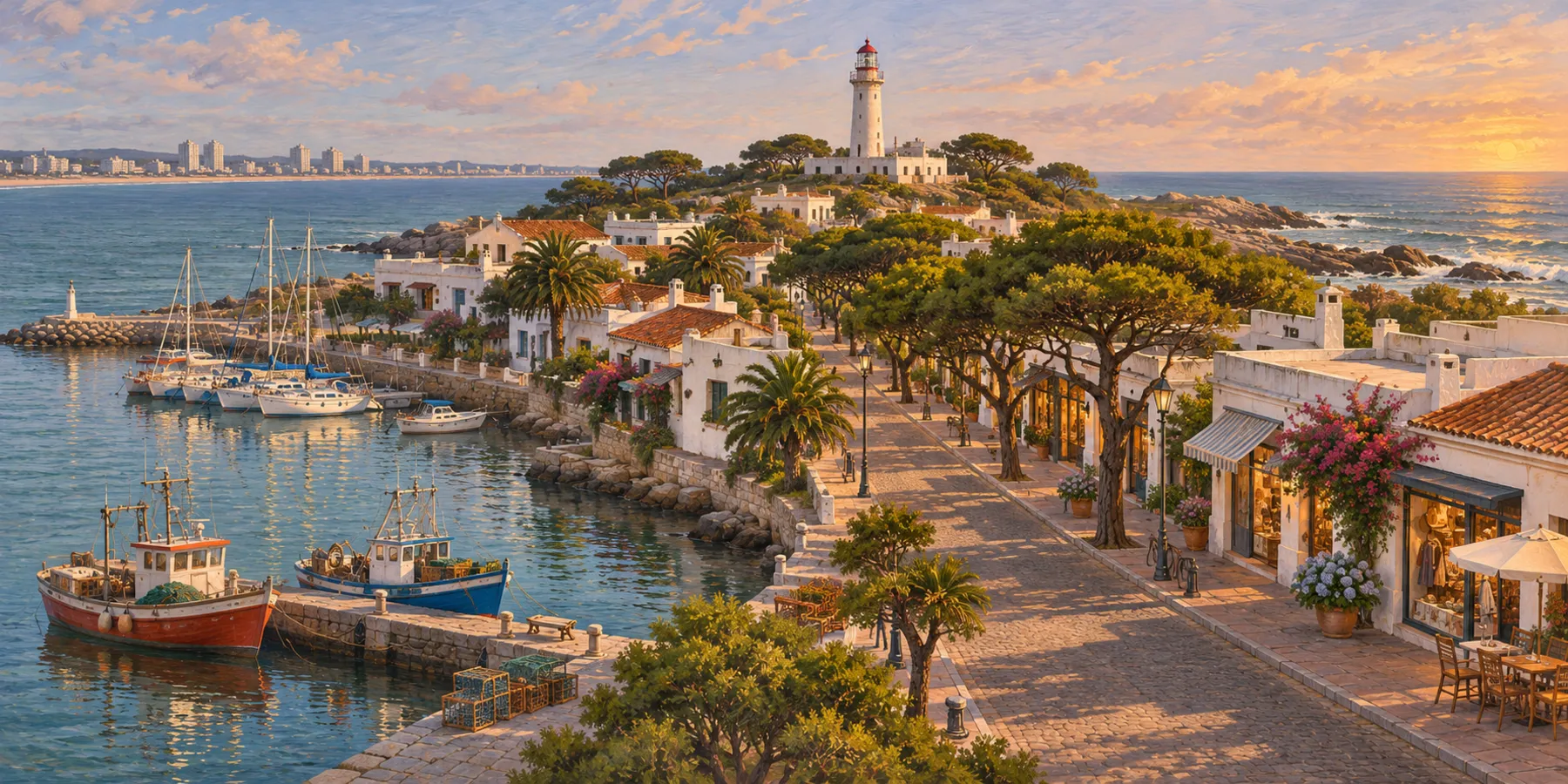
The port, officially Puerto Nuestra Señora de la Candelaria, sits on the bay side of the tip and fills with yachts and fishing boats in summer. Sea lions gather beside the fishermen's stalls, waiting for scraps from the day's catch, and they are the easiest wildlife sighting in Uruguay.
Watch them from the dock and do not feed or touch them: they are wild animals and can bite. Boat trips to Isla Gorriti, in the bay, and Isla de Lobos, home to a large sea lion colony offshore, leave from the port in season. Departures depend on the weather, so confirm on the day.
The lighthouse and the old tip
The Punta del Este lighthouse was built in 1860 to guide ships into the bay together with the light on Isla de Lobos. It stands among low houses near the tip, because its beam is the reason building heights are restricted in the oldest part of the Península; the towers only begin farther back.
A few steps away is the Iglesia de la Candelaria, a small church in sky blue and white that is one of the Península's most photographed buildings. Down on the rocks of the old quarter stands a separate small chapel, the Capilla de la Candelaria, which commemorates the first mass said to have been held on this shore; it can be cut off at high tide. The streets around both, toward the rocky shore, are the calmest part of the Península and a good place to see how the town looked before the towers.
Plaza Artigas and the artisans fair
Plaza Artigas, just off Gorlero, hosts the city's artisans fair. Stalls sell leather, knitwear, jewellery, ceramics and local crafts, and the fair is busiest on summer evenings after the beach. Opening hours vary by season, so check locally, and expect to pay in cash at some stalls.
A walking loop around the tip
A loop of two to three hours covers the main sights at an easy pace:
- Start at Los Dedos, at Parada 1 of Playa Brava, early in the morning before the crowds.
- Walk along the Brava side of the Península toward the tip, past Playa El Emir, a small surf beach between rocks.
- Continue around the rocky tip, with views across to Isla de Lobos and Isla Gorriti, to the lighthouse and the Candelaria church.
- Follow the shore to the port and the sea lions.
- Walk up Gorlero to Plaza Artigas for a coffee, then return along the Mansa side.
Our guide to Playa Brava and Los Dedos covers the sculpture and the Atlantic side in more detail.
Staying on the Península or outside it
The Península suits a short first visit or a car-free stay: you can walk to the port, both beaches and dozens of restaurants. The trade-offs are crowds and noise in peak weeks, very limited parking and older apartment stock in many buildings.
Families staying a week or more often prefer the middle paradas of the Mansa, a short drive away, where the beach is calmer and the evenings quieter. Our apartment at Parada 18 de la Mansa puts the Península a short ride east. For every zone side by side, read where to stay in Punta del Este.
Frequently asked questions
Where can I see sea lions in Punta del Este?
At the port on the Península, where they gather beside the fishermen's stalls. Watch from the dock and do not feed or touch them.
Can you walk around the Península?
Yes. It is flat and compact, and a loop from Los Dedos around the tip to the port and Gorlero takes two to three hours at an easy pace.
When was the Punta del Este lighthouse built?
In 1860, to guide ships together with the lighthouse on Isla de Lobos.
Where is the artisans fair?
In Plaza Artigas, just off Avenida Gorlero. It is busiest on summer evenings; hours vary by season.
Is it worth staying on the Península?
For a short, car-free visit, yes. For a longer family stay, the middle paradas of Playa Mansa are calmer and still close.
Sources and review notes
- La península de Punta del Este: el puerto, Gorlero y Los Dedos (El Observador) , checked 2026-11-13
- Historia de Punta del Este (InfoCasas) , checked 2026-11-13
- La Mano de Punta del Este (Wikipedia) , checked 2026-11-13
Next editorial review: 13 May 2027